Indiana Jones and the Christian Right
While Indiana Jones seemingly faces the Nazi army with nothing but a whip and severe look of exhaustion, what Hitler's minions don't realize is that Indiana also has the power of god and anime on his side.
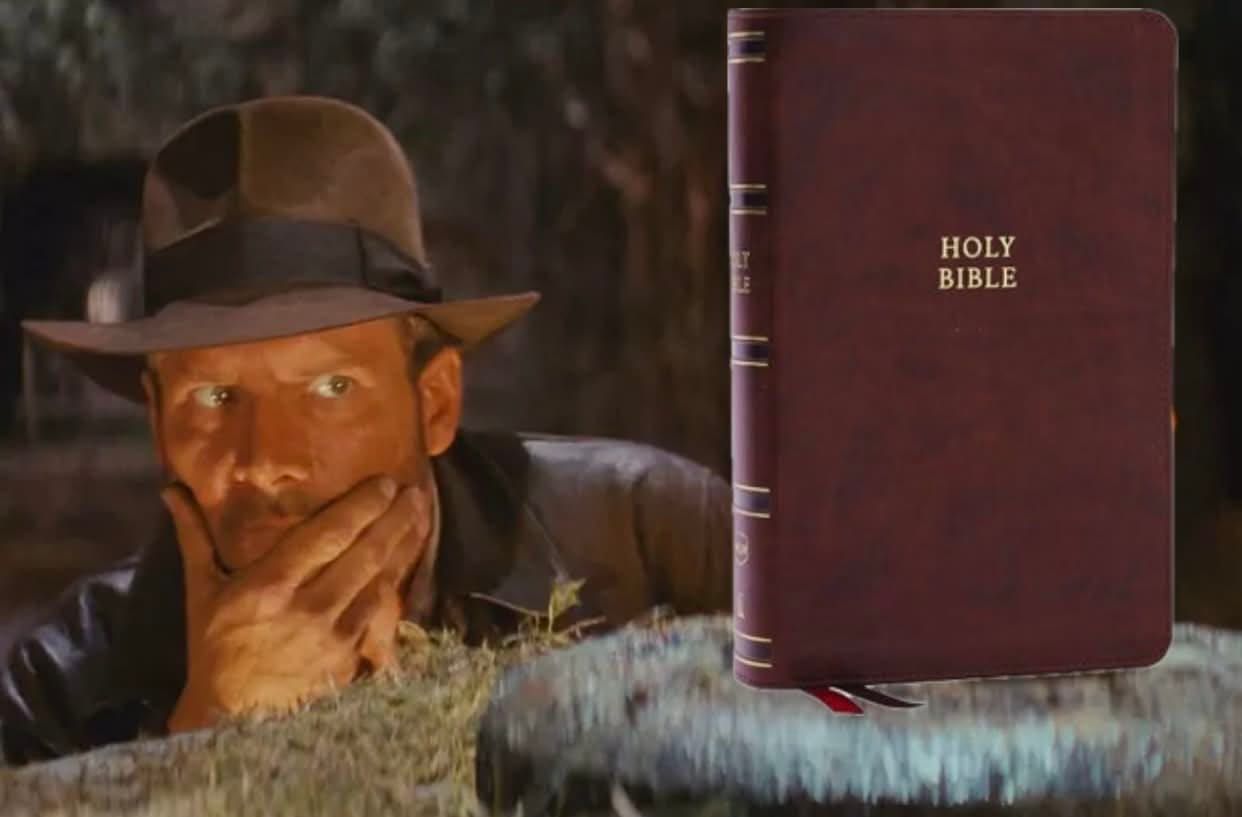
Ah, Indiana Jones, my favorite Nazi-punching archeologist. Created by none other than the Star Wars man himself, George Lucas. Indiana Jones, or Indy, made his big screen debut in 1981 with the film The Raiders of the Lost Ark, which eventually spawned several sequels, games, and a television series. Much like Star Wars, it became a cultural phenomenon. So much so that the sound of a whip crack and its signature theme, composed by John Williams, spark feelings of nostalgia and cause me to involuntarily hum along. It also shares a similarity with Star Wars in that it has deliberate anti-fascist and anti-Nazi messaging.
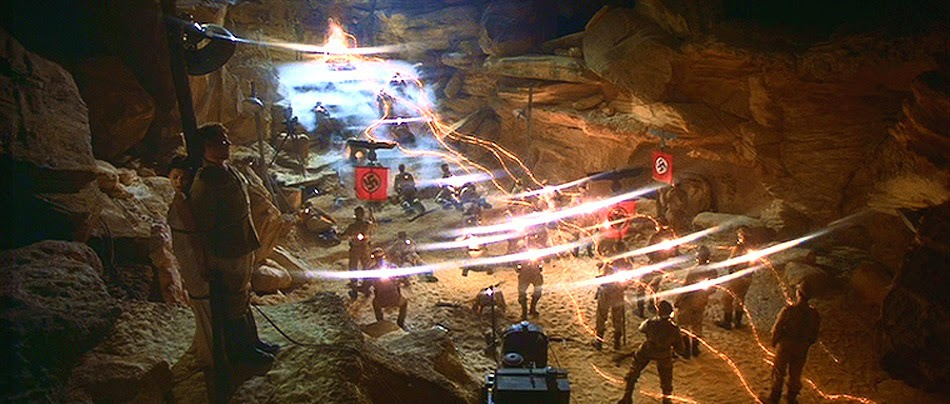
The Raiders of the Lost Ark is not just the first movie, but also the first to include Christian theology as its base. In it, Indy is tasked with stopping the Nazi search for the Ark of the Covenant. According to Exodus 40:20, the Ark was built by Moses to hold tablets engraved with the 10 Commandments given to him by God on Mt. Sinai. In the movie, Indy's colleague, Marcus Brody, says that the Ark in the Bible had the power to level mountains, rendering the army that carried it invincible. The closest example to Marcus's claim is in 1 Samuel 4:1-11, where the Ark was held by soldiers of Israel. While those that held the Ark did die, the opposing army feared that having the Ark was like having God with you, and that God could bring "plagues and wilderness" upon them if left alone. Indy’s quest to prevent the Nazis from uncovering the ancient relic is foiled as he is captured and forced to watch as they open it for the first time. Spirits and beams of light then arise from the container and kill every Nazi attending, leaving Indy untouched.
The third film, The Last Crusade, also deals with Indy halting the Nazi party's search for Christian artifacts. This time it's the Holy Grail, the cup Jesus drank from at the Last Supper. In the movie, it's said that whoever drinks from it will live forever. The origins of the Holy Grail are closely associated with Arthurian legend, but despite the lack of biblical evidence for its existence, it's still treated by the characters as a real Christian artifact. Much like the first, Indy is captured by the Nazis and forced to lead them to a room full of cups, where only one is the true cup of Christ. The main antagonist picks up what he thinks is the Grail and drinks from it. He then starts rapidly aging, turning into a skeleton before Indy's eyes, then is reduced to dust while the guardian of the Grail exclaims that he chose poorly.

In the 2024 video game, The Great Circle, Indy sets out to stop the Nazis from rebuilding Noah's Ark. Indy finds out that the Ark had the ability to teleport around the world, so that Noah could collect two of each animal before the great flood. The teleportation isn't explicitly mentioned in the book of Genesis, but it also says that Noah had lived for 600 years so, to be fair to Indy, a teleporting boat doesn't feel out of the realm of possibility. With this power, the Nazis would be able to move their forces at the blink of an eye, an evolution of the Blitzkrieg. At this point you should be able to say it with me:
Indy fails to stop them.
The Nazis succeed in building the biblical boat and embark on it, triggering a flood. Although Indy tries to fight, what kills the Nazis is the beam of light that shoots out from the Ark's steering wheel. Indy never stops the Nazis himself, the artifacts harnessing the power of god do. Plus, all of these instances of divine violence save Indy. He dedicates his life to preserving these artifacts, and keeping them safe from those that would wield them as weapons. The main message is of course to punch Nazis, but also the danger of Nazi bastardization of Christianity.

With this messaging, the timing of this franchise could be the most important part. As Raiders of the Lost Ark was released in 1981, the first year of Ronald Reagan's presidency, and conceptualized in the decade prior, which also contained the Carter administration. Prior to this, Christianity wasn't as prominent in American politics as a main factor for attracting voters. In 1977, Jimmy Carter really broke that notion when he was inaugurated as the first Evangelical President of the United States. The difference between Evangelical Christianity and other denominations is how focused it is on salvation and conversion. It revolves around the idea that the more Christian faith is included within society, the better.
The 1970s marked the first decade in which Evangelicals began to pay far more attention to the government. After the ruling Brown v. Board of Education and the institution of the Civil Rights Act, the United States slowly began to desegregate schools. As a result, many white students moved to private Christian institutions as public schools were among the first to be desegregated. In 1976, the IRS revoked the tax exempt status from one of these institutions, Bob Jones University, as it wasn't satisfied with any effort by Bob Jones to desegregate their school and remove any racist policies. Evangelical Christians viewed this as the government overstepping and became far more enthusiastic to go to the polls. When Carter was able to secure the presidency with the help of the Evangelical vote, right-wing leaders saw a new voter base and tried their best to draw them over with a single issue. They had been utilizing the Southern Strategy, but segregation became far less popular as a single issue in the 1970s. That's when they settled on abortion after the 1973 Roe v. Wade Supreme Court decision. There are two groups that helped organize both this movement and eventually Ronald Reagan's presidency:
- The Heritage Foundation, founded in 1973 by Paul Weyrich, Edward Feulner, and Joseph Coors (of beer fame).
- The Moral Majority, founded by Baptist and televangelist Jerry Falwell Sr.
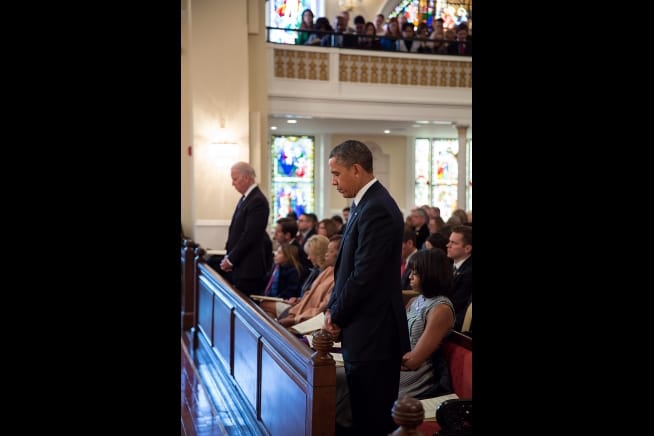
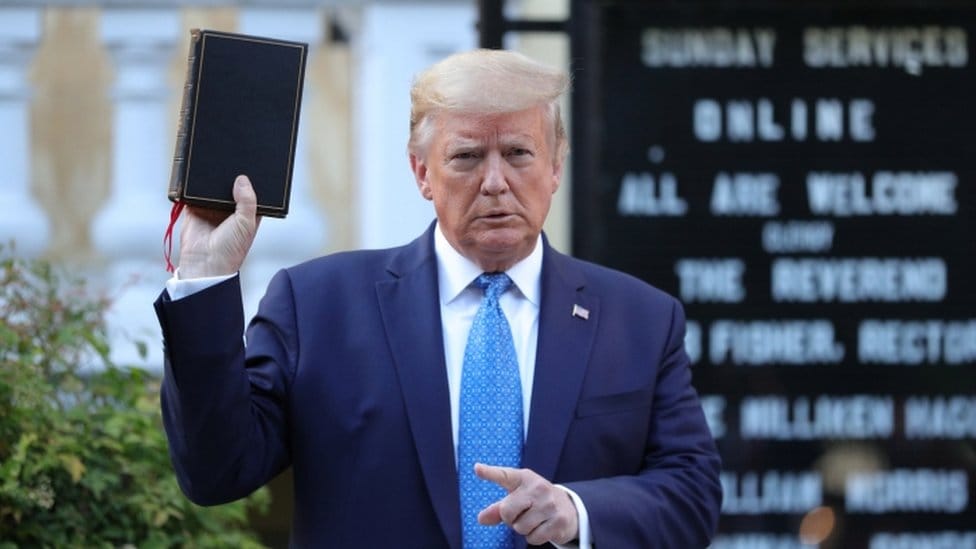
These were right-wing think tanks heavily funded by some of the wealthiest people in the country. Now with televangelism on the rise and an Evangelical in the White House, it became far easier for these organizations to market political involvement to church goers. Reagan continued to target these voters and spoke to thousands of Christians on the campaign trail in 1980, and his presidency repeatedly contained depictions of faith. The Heritage Foundation became a big influence for Reagan in the following years, producing the Mandate for Leadership which influenced a lot of his policymaking. With Reagan's landslide victories, they effectively provided a sought after blueprint for electoral victories. Presidents since then have showcased their Christian faith while on the campaign trail or in office.


Sources: AP, White House, Reagan foundation, BBC
Indiana Jones came at the perfect time, and hasn't stopped being relevant. The Christian Right has referred to God and the Bible to back up their claims for decades. Whether it be them referring to Leviticus 20:13 or Corinthians 6:9 to dispute gay rights, despite "homosexuality" appearing in the Bible due to a 1946 mistranslation, or George W. Bush saying that God told him to invade Iraq. Even if not every voter is Christian or agrees with their way of showing faith, it's hard to deny how much it has worked out for them. The way Evangelicalism has grown and gripped American policymaking is a testament to that. It's also important to remember that they're weaponizing a very old text that was written over centuries by different people with different perspectives and translated hundreds of times. There are passages that could be used to justify their prejudices, sure. However, there are also passages that disavow things like the love for wealth, for example. The whole of the text doesn't necessarily matter to them, though. Either way, it's a Christian artifact that's being used as a force for societal change and the oppression of people.
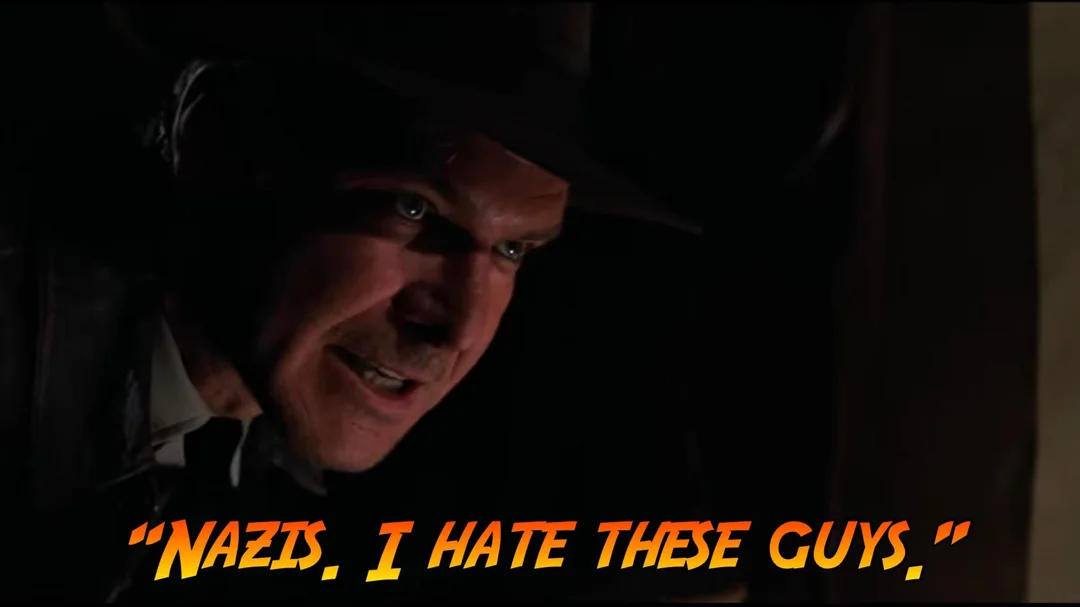
That's why Indiana Jones is so important. It's dedicated to showing so many refusals by Christian faith to be manipulated by Nazis, and makes fun of them along the way. It shows their carelessness when they open the Ark. It shows their ignorance when they choose the wrong Grail. It shows their insatiable lust for power when Noah's Ark eviscerates them. There is an importance behind depictions of a divine rejection of fascism, as so often the Christian Right would like us to see the opposite. Plus, despite his failures, Indy never stops trying to preserve these artifacts because the struggle against any sort of fascist movement is never a short affair. Persistence is one of the many keys that can unlock a better tomorrow, and the Christian Right's attempts to aim the power of god at us won't work so long as we do just that.
Persist.